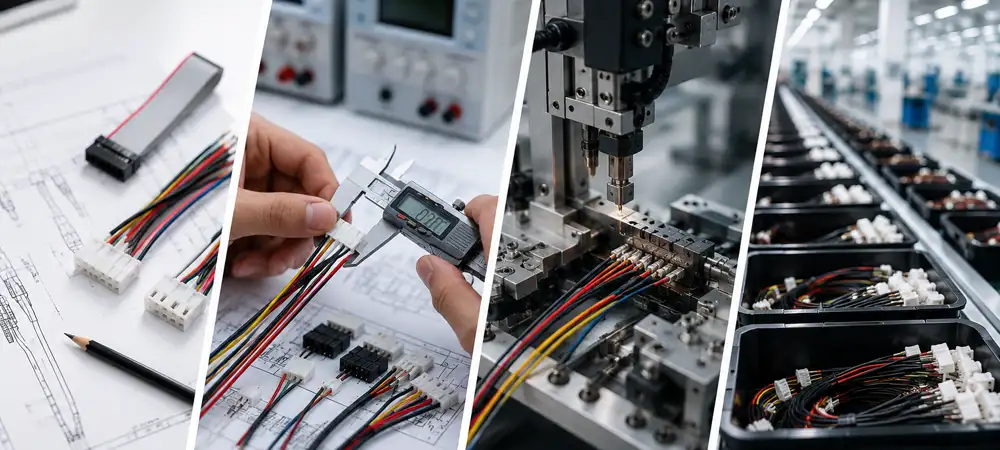
For OEM manufacturers, selecting the right wire or cable is an important part of product development. The cable must meet the product’s electrical, mechanical, dimensional, and assembly requirements while also being suitable for consistent mass production.
A well-defined OEM cable development process helps turn an initial concept or prototype into a reliable production-ready solution.
1. Understanding the Requirement
The process begins with understanding the customer’s application and technical requirements.
These may include:
- Wire and cable specifications
- Length and dimensions
- Conductor size
- Temperature requirements
- Connector and terminal requirements
- Stripping or tinning
- Colour coding
- Expected production volume
Customers can provide a sample, drawing, or technical specification as the starting point.
2. Prototype Development
Once the requirements are defined, a prototype can be developed for evaluation.
The prototype helps verify important factors such as:
- Physical fit
- Cable length
- Connector compatibility
- Flexibility
- Assembly requirements
- Electrical performance
This stage allows potential design improvements to be identified before moving into larger production.
3. Testing & Validation
Before mass production, the cable solution should be checked against the required specifications.
Depending on the application, testing may include electrical continuity, insulation performance, dimensional checks, connector inspection, and other application-specific quality tests.
Proper validation helps ensure that the cable performs consistently within the intended product.
4. Production Optimization
After the prototype is approved, the manufacturing process is optimized for repeatable production.
This may involve defining:
- Manufacturing processes
- Cutting and stripping specifications
- Termination methods
- Connector assembly
- Quality checkpoints
- Packaging requirements
The objective is to achieve consistent quality while making production efficient.
5. Mass Production
Once the specifications and production process are finalized, the cable assembly can move into bulk manufacturing.
Quality checks throughout production help maintain consistency from one batch to another, which is particularly important for OEM products manufactured in high volumes.
Why OEMs Choose Customized Cable Solutions
A customized cable solution can provide advantages over adapting a standard cable, including:
- Better product fit
- Simplified assembly
- Reduced manual processing
- Consistent cable configuration
- Application-specific design
- Easier integration into production
Alcop Cables: From Concept to Production
Alcop Cables provides custom wire, cable, and interconnect solutions based on customer samples, drawings, and specifications.
With capabilities for processes such as cutting, stripping, tinning, colour coding, and connector assembly, Alcop supports OEM requirements from prototype development through bulk production.
Whether the application involves electronics, appliances, LED lighting, sensors, home automation, vehicle telematics, or drones, selecting the right cable partner can play an important role in achieving reliable and efficient production.
Conclusion
Developing an OEM cable solution is more than simply selecting a wire. It involves requirement analysis, prototyping, testing, production optimization, and quality-controlled manufacturing.
With the right development process and manufacturing partner, OEMs can move from an initial cable concept to a production-ready solution designed around their specific requirements.