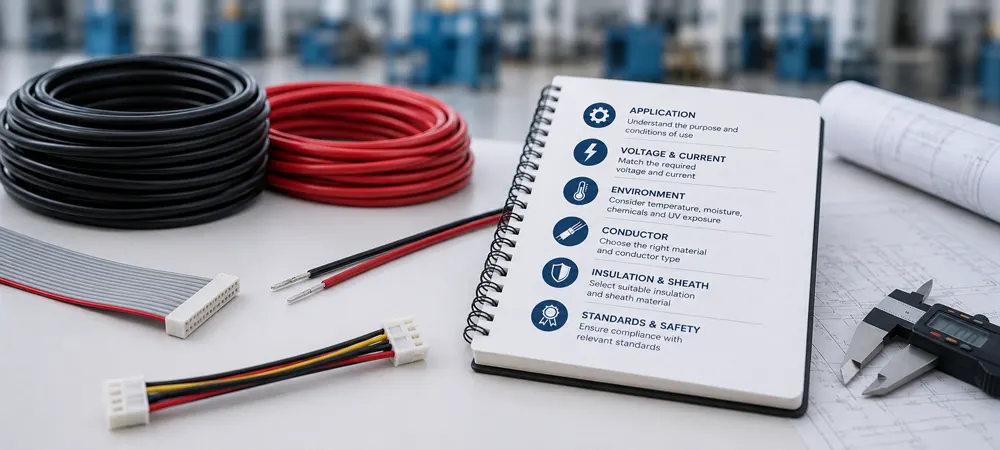
Choosing the right wire or cable is an important part of designing any electrical, electronic, or industrial product. The right cable can improve performance, safety, durability, and assembly efficiency, while the wrong choice can lead to overheating, signal loss, premature failure, or unnecessary production costs.
With applications ranging from electronic assemblies and home automation to LED lighting, sensors, vehicle telematics, appliances, and drones, cable requirements can vary significantly from one application to another.
So, how do you choose the right wire and cable for your application?
Here are the key factors to consider.
1. Understand Your Application Requirements
Before selecting a wire or cable, start by understanding exactly where and how it will be used.
Consider questions such as:
- Is the cable being used for power or signal transmission?
- Will it be installed inside an appliance or electronic device?
- Does the application require frequent movement or flexibility?
- Will the cable be exposed to heat, moisture, chemicals, or mechanical stress?
- Is space limited inside the product?
- Does the application require connectors or a complete cable assembly?
For example, a compact sensor may require a thin, flexible, high-temperature wire, while a vehicle telematics application may benefit from colour-coded, cut-to-length wires for easier identification and assembly.
2. Select the Correct Conductor Size
The conductor size plays an important role in determining how much current a wire can safely carry.
A conductor that is too small for the required load can generate excessive heat. Conductor ampacity depends on factors such as conductor size, insulation temperature rating, installation conditions, and the number of current-carrying conductors.
When selecting conductor size, consider:
- Required current
- Operating voltage
- Cable length
- Allowable voltage drop
- Ambient temperature
- Installation conditions
- Applicable electrical standards
For precise electrical designs, conductor sizing should always be verified against the relevant standards and application requirements.
3. Consider the Operating Voltage
Every wire and cable has a specified voltage rating.
The selected cable should have a voltage rating appropriate for the application. Voltage rating is particularly important in power applications and equipment where electrical safety is critical.
However, voltage rating alone should not determine cable selection. The conductor, insulation, temperature rating, environmental conditions, and applicable certification requirements must also be considered.
4. Choose the Right Insulation Material
The insulation surrounding a conductor protects against electrical contact and environmental conditions.
Different insulation materials provide different levels of:
- Temperature resistance
- Flexibility
- Moisture resistance
- Oil and chemical resistance
- Abrasion resistance
- Flame performance
- Mechanical durability
For example, wire and cable constructions can have different temperature ratings for dry and wet environments, so the insulation must be selected according to the actual operating conditions.
For compact electronics, flexibility and small outer diameter may be more important. For industrial environments, durability and environmental resistance may take priority.
5. Consider Space and Cable Diameter
Modern electronic products are becoming smaller and more compact. This means the available space for internal wiring can be limited.
A cable with the correct electrical specifications but excessive outer diameter may still be unsuitable for a compact product.
Therefore, consider:
Electrical performance + mechanical dimensions + installation space
Alcop’s manufacturing capabilities include cables with outer diameters as small as 0.7 mm, which can be useful for compact electronic applications.
How Alcop Can Help
Choosing the right cable can become more complex when the application has specific size, temperature, connector, or assembly requirements.
Alcop Cables provides wires, cables, harnesses and interconnect solutions for OEM and industrial applications, with in-house manufacturing, quality control, testing capabilities and customized production.
From standard wires and cables to customized cable assemblies, solutions can be developed according to customer drawings, samples and specifications.
If you are developing a new electronic product or looking for a reliable cable manufacturing partner, the right approach is to discuss your application requirements before finalizing the cable specification.
Need a wire or cable customized for your application? Contact Alcop Cables to discuss your requirements.